From food industry by-product to premium product: the Italian model of innovation, safety, and reduced environmental impact.
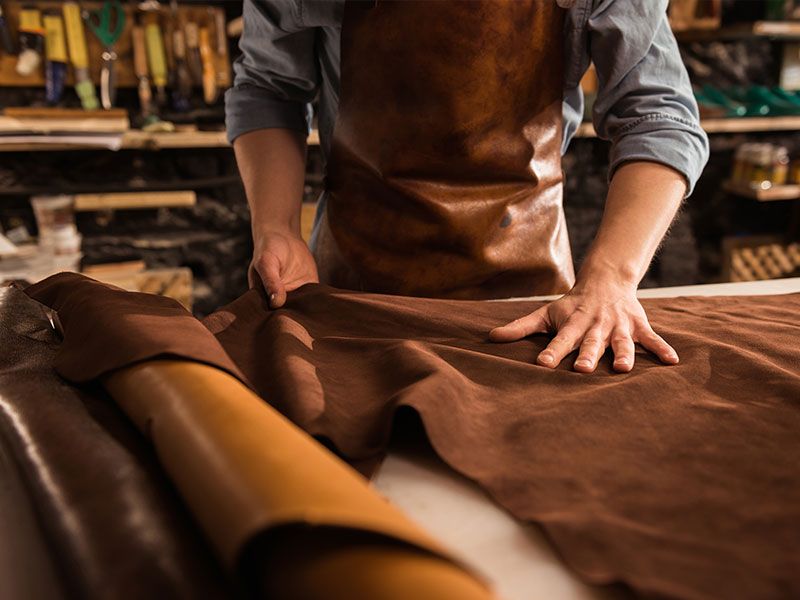
Leather is one of the oldest materials used by humans, yet also one of the most sustainable. Its history dates back to the dawn of humanity, when early humans chose not to discard the hides of animals used for food, but instead transformed them into rudimentary clothing. That seemingly simple act represented one of the first examples of resource recovery and circular economy.
Thousands of years later, this principle still holds true, even if it is no longer always taken for granted. Leather is, in fact, a recovered material: it comes from by-products of the food industry and is transformed into a highly valuable product. For this reason, it is essential to clearly communicate the role of the tannery in recovering this resource and the sector’s commitment—particularly the Italian sector—to continuously improving its environmental performance.
The tanning industry plays a crucial role in recovering a large amount of material that would otherwise need to be disposed of. Over 99% of processed hides come from cattle and small ruminants and are by-products of the meat industry. Technically, these are considered Animal By-Products (ABPs), whose recovery is regulated by European, national, and local legislation.
Globally, tanneries recover approximately 1,700 square kilometers of raw hides each year from human food production. Italy accounts for about 8% of this total, approximately 125 square kilometers. In a world where consumption of animal proteins remains high, the contribution of tanneries is therefore essential to transforming potential waste into a valuable resource.
From By-Product to Excellence: this is the transformation that makes leather a unique material. Through the tanning process, a by-product of the food industry becomes a high-quality product capable of delivering long-lasting technical and aesthetic performance. Shoes, bags, jackets, sofas, or car seats made from leather stand out for their durability and ability to retain value and functionality far longer than many alternative materials. Leather also improves with use, developing a patina and character that tell the story of its owner.
The Italian tanning sector today represents an advanced industrial model, also from a sustainability perspective. Since 2003, the sector has relied on a fundamental monitoring and transparency tool: the Sustainability Report prepared by UNIC – Italian Tanneries, the association representing industry companies. The report documents the commitment of over 1,200 small and medium-sized enterprises that have been investing for years in continuously improving their environmental, social, ethical, and economic performance.
The results are tangible. Over the last ten years, Italian tanneries have reduced water consumption by 16%, chemical use by 17%, and energy consumption by 8%—a figure that rises to 28% over fifteen years. At the same time, atmospheric emissions decreased by 38% and waste production by 26%.
Significant results are also evident in water treatment: treatment levels reach 97.4% for COD and 99.5% for Chromium III, demonstrating the sector’s strong commitment to environmental protection.
Leather tanned in Italy also guarantees very high safety standards for the final consumer. The use of chemicals is regulated by strict European legislation, such as the REACH and POP regulations, but the sector often goes beyond legal requirements. Companies carry out additional checks on finished products to ensure correct chemical management throughout the production process.
Collaboration with major fashion houses, often pursuing standards even stricter than regulations, has further driven technological investments and greater attention across the entire supply chain. Key topics include animal welfare and raw material traceability, increasingly central to the global market.
Workplace safety is another important focus. According to the latest available data, the incidence of accidents in Italian tanneries is 26.1 per 1,000 employees, a 43% reduction compared to fifteen years ago, with an overall decline in incidents of 56%.
A key role in this area is played by ICEC – Institute for the Certification of Tannery Quality, which over the last twenty-five years has developed numerous standards and certifications covering environmental, social, ethical, and economic aspects of production. Today, more than 50% of the sector’s turnover comes from companies holding at least one ICEC certification.
The circular nature of leather is also evident in the recovery of tannery process by-products. Sludges, trimmings, shavings, and other residues are transformed into new raw materials for other industries. From these materials, fertilizers and biostimulants for agriculture, gelatin and collagen for the food industry, and granules and composites for construction are produced.
Thanks to this integrated approach, leather stands as a concrete example of circular economy applied to industry. The Italian tanning sector continues to be a global reference point for international supply chains in footwear, leather goods, clothing, furniture, and automotive industries.